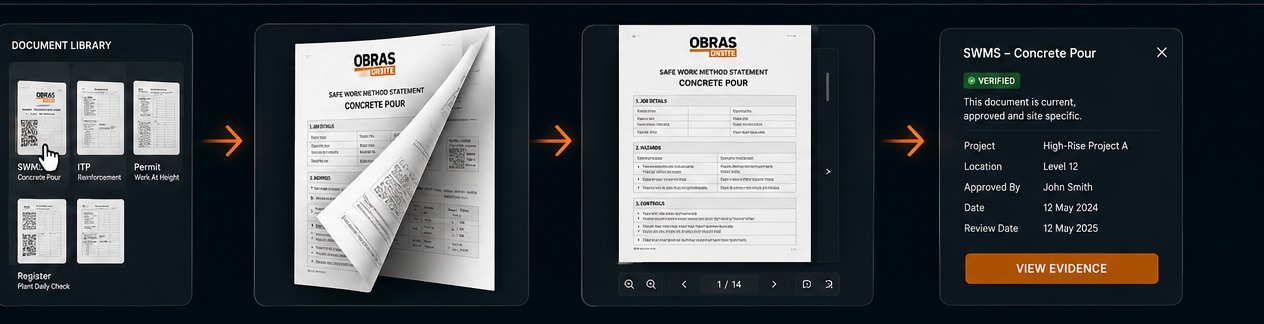
Whether you're writing one from scratch or filling in a template, a good SWMS follows the same logic. Here's the process competent persons use.
- Confirm it's high-risk construction work. Check the job against the 18 HRCW activities. If it's on the list, you need a SWMS.
- Break the job into steps. List the tasks in the order they'll actually happen - set-up, the work itself, pack-up.
- Identify the hazards for each step. What could hurt someone? Falls, electrocution, crushing, dust, noise, traffic, collapse - be specific to the step.
- Assess the risk. Rate each hazard's likelihood and consequence (a risk matrix gives you a Low / Medium / High / Extreme rating). This sets your initial risk.
- Apply the hierarchy of control. Pick controls in order: eliminate first, then substitute, isolate, engineering, administration, and PPE last. PPE alone is never enough for high-risk work.
- Record the residual risk. After controls, what's the remaining risk? It should be as low as reasonably practicable.
- Add the detail. Plant and equipment, qualifications/competencies, permits, PPE, and the relevant legislation, Codes of Practice and Australian Standards.
- Consult your workers. The crew doing the job must help develop the SWMS - they know the real hazards. This is a legal requirement, not a nicety.
- Sign on. Every worker reads the SWMS and signs on before high-risk work starts. Keep the signed copy on site.
- Use it, monitor it, review it. Work to the SWMS. Review and update it whenever the work, site, plant or crew change, after any incident, or when the law changes.
The biggest mistake: grabbing a generic SWMS and never tailoring it. The job steps, hazards and controls have to match your actual site, plant and people. A template is a brilliant starting point - but you must make it yours and have a competent person sign it off.
Start from a professional template
Writing every SWMS from a blank page is slow and easy to get wrong. Our SWMS library gives you a professionally-written starting point for 200 trades and activities - job steps, hazards, colour-coded risk ratings and controls already done. You add your logo, tailor it to your site, get it signed off, and you're ready. See exactly how it works →